
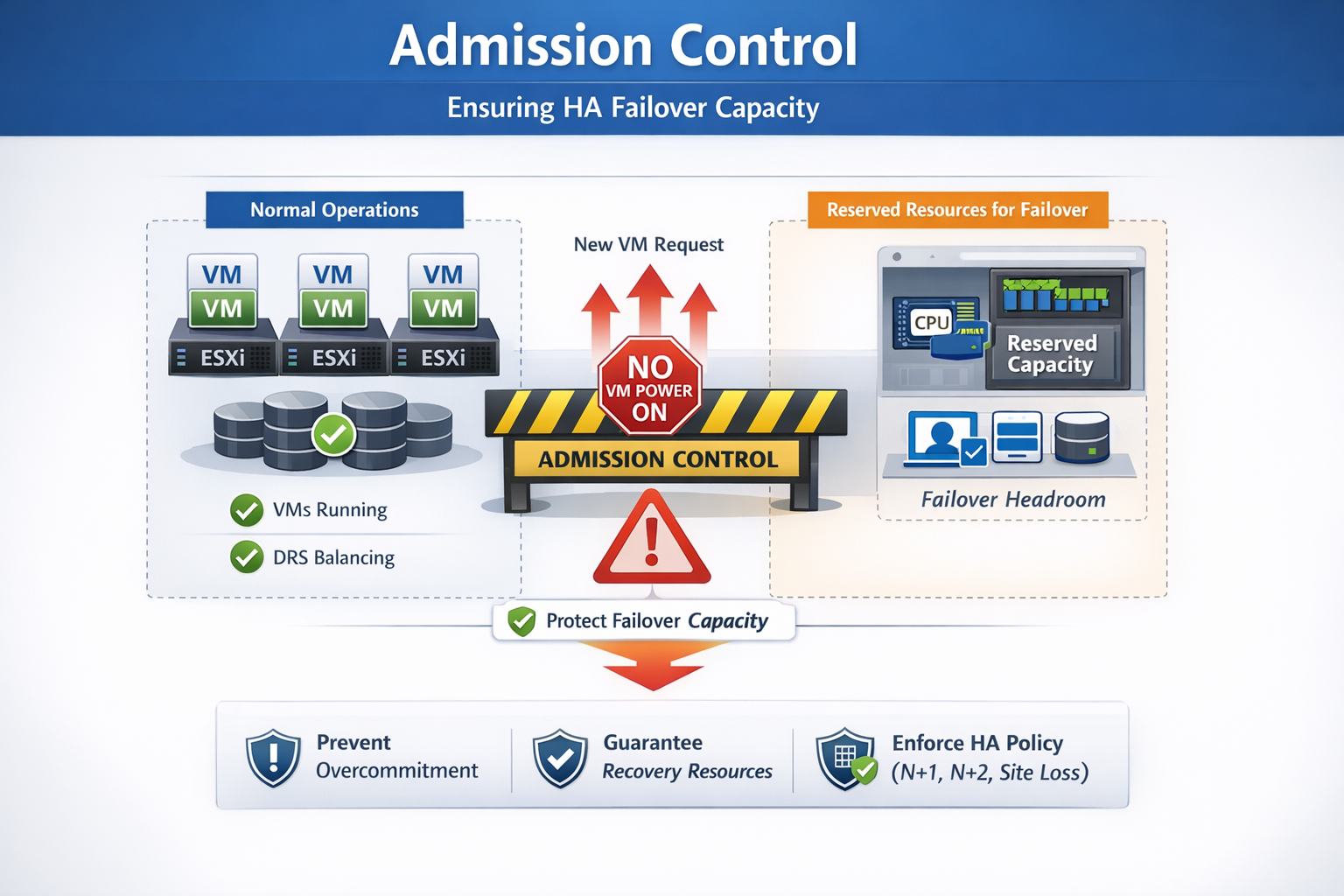

Admission Control is the policy engine within VMware vSphere HA that enforces survivability guarantees.
Its purpose is not performance optimization—it is risk containment. Admission Control ensures that the cluster never commits more compute resources than it can safely recover after a defined failure scenario (host, disk group, or site).
Admission Control is the guardrail that converts “high availability” from a best‑effort feature into an enforceable SLA.
Without it, HA still restarts VMs—but with no guarantee that capacity exists to do so.
Why Admission Control Exists
Architecturally, every HA cluster is designed around a failure domain:
- Loss of 1+ hosts
- Loss of a vSAN disk group
- Loss of an entire site (stretched cluster)
Admission Control ensures:
- The cluster always has reserved headroom
- That headroom matches the failure domain you designed for
- New workloads do not silently erode recovery guarantees
This is capacity governance, not just HA configuration.
How Admission Control Works
Admission Control blocks power-on operations (or vMotion with power-on) when doing so would violate the cluster’s ability to survive its worst‑case failure scenario.
Key points:
- It does not reclaim resources
- It does not throttle running workloads
- It only acts at VM power-on / restart time
Once a VM is running, Admission Control assumes that capacity has already been committed.
Admission Control Policies (Architectural Trade‑offs)
Host Failures Cluster Tolerates (Slot-Based or Percentage-Based)
Slot Policy (Legacy / Not Recommended)
- Calculates fixed “slots” based on largest VM
- Overly conservative
- Poor fit for modern, heterogeneous clusters
✅ Architect guidance: Avoid unless supporting legacy designs.
Percentage-Based Policy (Architect Standard)
Reserves a percentage of CPU and memory across the cluster.
Example:
- 25% CPU + 25% Memory reserved
- Guarantees recovery from the loss of ~1 out of 4 hosts
Why architects prefer it
- Scales cleanly
- Works with uneven VM sizing
- Predictable and auditable
Design responsibility
- You must size percentages based on:
- N+1 / N+2 requirements
- Oversubscription strategy
- Peak utilization, not averages
Dedicated Failover Hosts
Reserves specific hosts exclusively for failover.
Use cases
- Regulatory environments
- Fixed hardware pools
- Extremely deterministic recovery models
Architectural downsides
- Idle capital
- Operational rigidity
- Poor elasticity
✅ Best suited for regulated or static environments, not dynamic enterprise clusters.
Admission Control in vSAN Clusters
Admission Control becomes non‑negotiable in vSAN environments.
Why?
Because compute recovery without storage quorum is meaningless.
Key interactions:
- HA Admission Control ensures CPU/memory
- vSAN ensures object availability (FTT, RAID level)
Architect implication:
- You must size both layers together
- Admission Control does not account for:
- vSAN object repair time
- Rebuild I/O contention
- Disk group failure concurrency
✅ Best practice: Over‑reserve compute slightly in vSAN clusters to absorb rebuild pressure.
What Happens If You Disable Admission Control
You Gain:
- Higher apparent utilization
- Fewer “cannot power on VM” events
- Short‑term operational flexibility
You Lose:
- Guaranteed HA recovery
- Predictable failure outcomes
- Auditability of availability claims
Real‑world consequence:
HA becomes “best effort,” and recovery order becomes first‑come, first‑served.
This is often acceptable in:
- Dev/Test clusters
- Non‑production labs
Rarely acceptable in regulated, manufacturing, or research environments
Architect-Level Best Practices
✅ Use Percentage-Based Admission Control
✅ Design for explicit failure scenarios (N+1, site loss)
✅ Align Admission Control with:
- vSAN FTT policies
- Change management
- Capacity forecasting
- Review Admission Control after:
- Hardware refresh
- Host count change
- Large VM onboarding
- Never disable Admission Control in:
- Production stretched clusters
- Manufacturing / OT environments
- Regulated workloads
Summary
Admission Control is the mechanism that enforces your availability promise.
If HA defines what should happen, Admission Control defines whether it is allowed to happen.
Disabling or misconfiguration does not remove risk—it conceals it until failure occurs, when remediation is no longer possible.